Paid ads can drive traffic to your online store. So can social media, email campaigns, and influencer partnerships. But none of those channels keep working when you stop paying for them.
Ecommerce SEO marketing is different. Done right, it builds a foundation of organic visibility that compounds over time — bringing in qualified buyers month after month without a cost-per-click attached to every visit.
Why SEO Is the Most Underutilized Ecommerce Channel
Most ecommerce businesses lean hard on paid search and social advertising because the results are immediate and measurable. SEO requires more patience, and that patience is often mistaken for ineffectiveness.
The data tells a different story. Organic search consistently drives more traffic than any other channel for established ecommerce sites, and those visitors convert at rates that rival or outperform paid traffic — without the margin erosion that comes from rising ad costs. When a product page ranks on page one for a high-intent keyword, it becomes a 24/7 sales asset. No budget required to keep the lights on.
Keyword Research Built Around Buying Intent
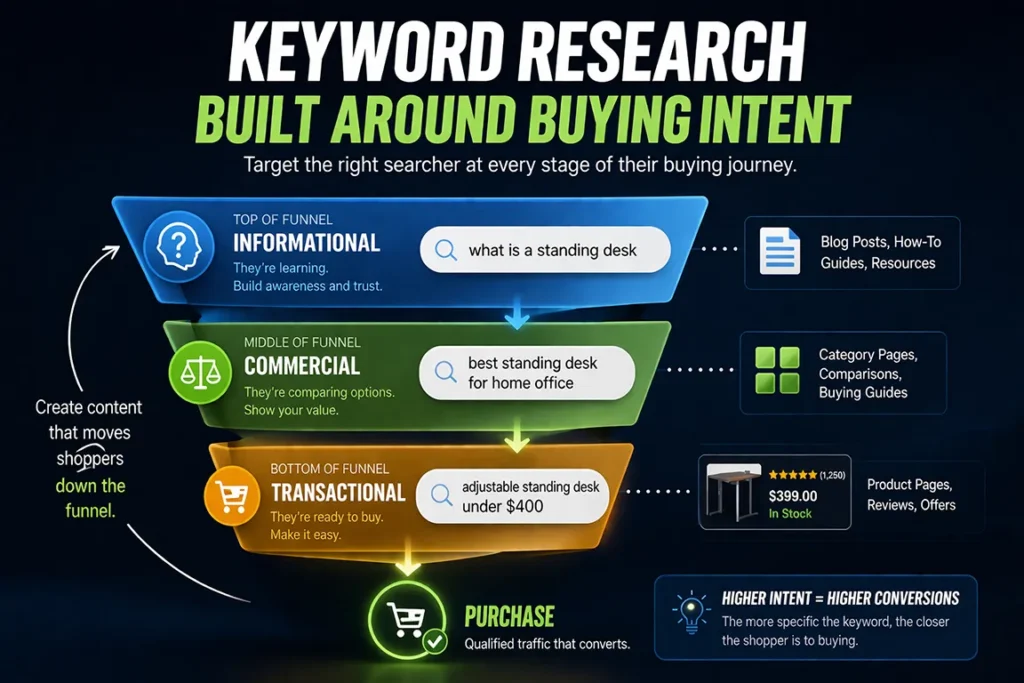
Generic traffic doesn’t pay the bills. A visitor who lands on a product page because they searched “what is a standing desk” is in a completely different headspace than someone who searched “adjustable standing desk under $400.” Ecommerce SEO marketing lives or dies by the ability to target the second type of searcher.
Effective keyword research for ecommerce means mapping intent at every stage of the funnel. Informational content — buying guides, comparisons, how-to articles — captures shoppers early and builds trust. Category pages target mid-funnel browsers who know what they want but haven’t committed to a brand. Product pages go after bottom-funnel buyers who are ready to purchase and just need the right offer in front of them.
Tools like Ahrefs, SEMrush, and Google’s own Search Console surface the specific terms your potential customers are using. The goal isn’t to find the highest-volume keywords — it’s to find the highest-intent keywords your site can realistically compete for.
Product Page Optimization: Where SEO Meets Conversion
A product page has to do two things simultaneously: convince Google it’s the most relevant result for a given search, and convince the shopper to buy. Those goals aren’t in conflict — they’re complementary — but most ecommerce sites sacrifice one for the other.
Start with the basics:
- Unique product descriptions — Manufacturer copy gets used across dozens of sites, which means zero differentiation in Google’s eyes. Write original descriptions that speak to your customer’s specific needs and concerns.
- Keyword-rich title tags and meta descriptions — These are the first thing a shopper sees in search results. They should be compelling and accurate, not just stuffed with terms.
- Structured data markup — Schema markup for products surfaces price, availability, and review ratings directly in search results, improving click-through rates before the shopper even lands on the page.
- Image optimization — Descriptive file names and alt text help images appear in Google Image Search and contribute to overall page relevance.
Reviews deserve special attention. User-generated content in the form of product reviews adds fresh, keyword-rich text to product pages continuously — and it builds the social proof that converts browsers into buyers.
Category Pages Are Your SEO Power Players
Individual product pages matter, but category pages are where ecommerce SEO marketing often wins or loses. A well-optimized category page can rank for broad, high-volume terms that would be impossible to target at the product level.
Most ecommerce sites treat category pages as pure navigation — a grid of products and nothing else. That’s a missed opportunity. A category page for “women’s trail running shoes” that includes a well-written introduction, relevant buying criteria, and naturally integrated keywords gives Google something to work with. It also gives the shopper context that builds confidence.
The investment in category page content pays dividends across the entire category, not just a single product.
Technical SEO Considerations Unique to Ecommerce
Ecommerce sites face technical SEO challenges that most content sites never encounter. The bigger the catalog, the more acute those challenges become.
Faceted navigation is one of the most common culprits. When a site allows shoppers to filter products by size, color, price, and brand, those filter combinations can generate thousands of unique URLs — most of which are near-duplicate pages that dilute crawl budget and confuse search engines. Managing this through canonical tags, noindex directives, or parameter handling in Google Search Console is essential for any site with a large catalog.
Site speed is equally critical. Ecommerce sites tend to be image-heavy and feature-rich, which creates performance drag. Google’s Core Web Vitals metrics directly factor into rankings, and a slow product page doesn’t just hurt SEO — it costs sales. Studies consistently show conversion rates drop sharply as page load time increases past two to three seconds.
Crawlability, duplicate content from product variants, and thin pages created by out-of-stock items rounding out the technical checklist that separates well-ranking ecommerce sites from ones that can’t seem to break through.
Content Marketing as a Sales Driver
A blog isn’t just a branding exercise for ecommerce businesses — it’s a direct revenue channel when built around the right topics.
Buying guides, product comparisons, and “best of” roundups capture shoppers in research mode and funnel them toward specific product pages. A home goods retailer that publishes a well-optimized guide to “choosing the right cookware for a gas stove” isn’t just earning organic traffic — it’s earning traffic from shoppers who are actively deciding what to buy. Internal links from that guide to relevant product and category pages move that intent closer to a transaction.
This kind of content marketing also earns backlinks naturally. Informative, well-researched buying guides attract links from bloggers, journalists, and review sites — which strengthens the domain authority that lifts every page on the site.
Building Authority in a Competitive Ecommerce Landscape
Domain authority is the tide that raises all ships. A strong backlink profile doesn’t just help individual pages rank — it gives the entire site a competitive advantage that compounds over time.
For ecommerce, link building often flows through the content strategy. Original research about industry trends, data-driven reports, and genuinely useful resources attract links from publications that would never link to a product page directly. PR campaigns around new products or brand milestones can earn coverage from trade publications and mainstream media. And supplier or manufacturer relationships often come with co-marketing opportunities that include backlinks from authoritative domains.
It’s a slower build than buying links. It’s also the only kind that lasts.
Frequently Asked Questions About Ecommerce SEO Marketing
How is ecommerce SEO different from regular SEO?
The fundamentals are the same, but ecommerce SEO deals with unique challenges: large product catalogs, faceted navigation, duplicate content from product variants, and the need to balance search optimization with conversion optimization on every page. The scale and commercial intent of ecommerce sites require a more technical and structured approach than a typical content site.
How long does ecommerce SEO take to show results?
Most ecommerce sites begin seeing meaningful organic growth within four to six months of a focused SEO effort. Highly competitive categories may take longer, while niche products with lower competition can rank faster. The key is consistency — SEO compounds over time, and sites that maintain their strategy see accelerating returns.
Should ecommerce businesses do SEO and paid search simultaneously?
Yes. Paid search delivers immediate visibility while organic rankings build. Over time, as organic traffic grows, businesses can reduce paid spend in categories where they rank organically — improving margins without sacrificing visibility.
What’s the most common ecommerce SEO mistake?
Using manufacturer-supplied product descriptions. It’s the fastest way to have your product pages compete against dozens of other sites using identical copy, with no differentiation and no chance of outranking anyone. Unique, customer-focused product descriptions are one of the highest-ROI investments in ecommerce SEO.
Does site structure matter for ecommerce SEO?
Significantly. A logical, shallow site structure — where any product is reachable within three clicks from the homepage — makes it easier for search engines to crawl and index the full catalog and ensures that link equity flows efficiently from high-authority pages to product and category pages.
Let’s Build a Search Strategy That Drives Real Revenue
Ecommerce SEO marketing isn’t a set-it-and-forget-it tactic. It’s an ongoing strategy that requires technical expertise, content investment, and a deep understanding of how your customers search. The Nozak Consulting team has helped businesses across industries build organic search into their most reliable revenue channel — and we’d love to do the same for yours. If you’re ready to stop leaving organic traffic on the table, schedule a free strategy session today.
