
Hreflang tags are small pieces of code with an outsized impact. When they work correctly, they tell search engines which version of a page to serve to which audience — English speakers in Canada get one version, French speakers in Quebec get another. When they break, search engines guess. And they often guess wrong.
The problem is that hreflang errors are nearly invisible without the right tools. A site can look perfectly functional to every visitor while quietly sending the wrong language versions to the wrong audiences, hemorrhaging rankings in regional search results it should be winning.
What Hreflang Tags Actually Do
Hreflang is an HTML attribute that signals to Google and other search engines the language and regional targeting of a specific page. A Canadian home care company serving both English and French-speaking clients, for example, needs search engines to understand that one URL is intended for English-speaking Canadians and another is intended for French-speaking Canadians in Quebec — and that neither should be treated as duplicate content.
Without hreflang, Google sees two pages covering the same topic in different languages and makes its best guess about which one to rank and where. That guess might be right. It frequently isn’t.
Why Hreflang Implementation Goes Wrong
Hreflang is notoriously easy to misconfigure. The syntax is strict, the tag relationships are reciprocal, and a single error in one page’s markup can undermine the entire implementation across the site.
The most common failure points aren’t obscure edge cases — they show up constantly on audits:
- Missing return tags — Every hreflang relationship must be declared on both pages. If the English page references the French page but the French page doesn’t reference the English page back, the signal is broken.
- Incorrect language codes — Hreflang uses ISO 639-1 language codes and ISO 3166-1 alpha-2 region codes. Using “fr” when you need “fr-ca” to target French-speaking Canada is a meaningful distinction that search engines take seriously.
- Inconsistent URLs — If one page uses a trailing slash and another doesn’t, or if one references HTTP while the other is served over HTTPS, the tags won’t match and the signal fails.
- No x-default tag — The x-default attribute tells search engines which page to serve when no other language variant matches a user’s settings. Sites without it leave an unnecessary gap in their international targeting.
Any one of these issues is enough to degrade performance in regional search results. Multiple issues compounding across a large site can effectively erase international SEO value built over years.
The Best Hreflang Checker Tools
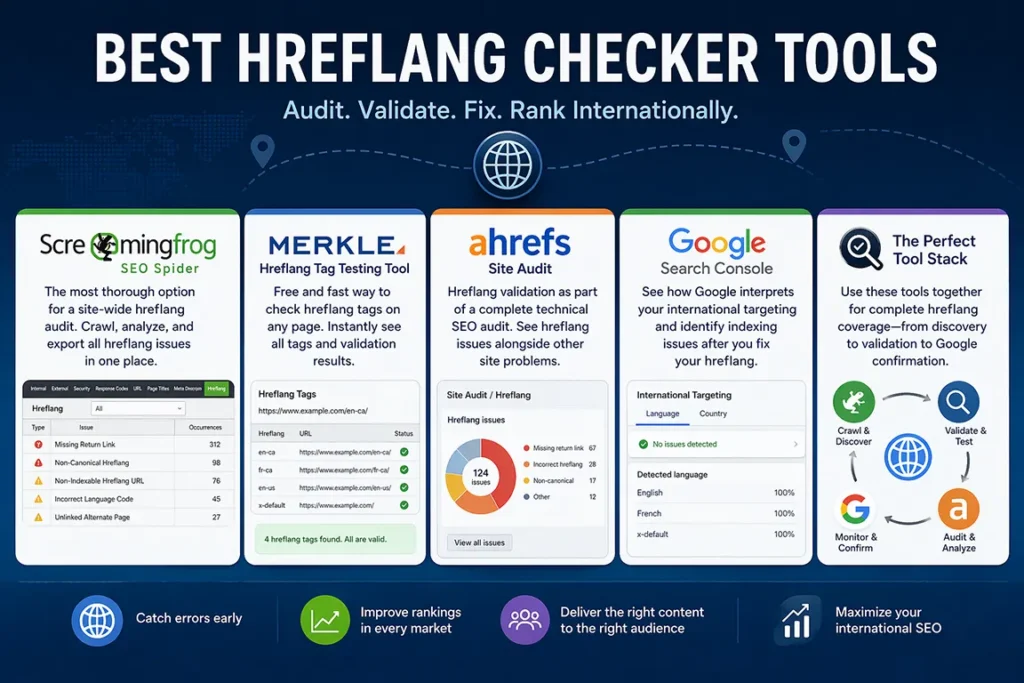
No single tool catches everything, but a combination of two or three covers the full picture reliably.
Screaming Frog SEO Spider is the most thorough option for a site-wide hreflang audit. Its dedicated hreflang tab surfaces every tag across the site, flags missing return links, identifies incorrect codes, and highlights URL mismatches — all in a single crawl. For any site with more than a handful of language variants, this is the most efficient way to get a complete view of what’s working and what isn’t.
Merkle’s Hreflang Tag Testing Tool is free and requires no software installation. Paste in a URL and it returns a complete readout of that page’s hreflang tags along with validation for each one. It’s not built for site-wide audits, but it’s the fastest way to spot-check individual pages or verify a fix after implementation.
Ahrefs Site Audit includes hreflang validation as part of its broader technical SEO scan. For teams already using Ahrefs for keyword research and backlink analysis, it provides a convenient consolidated view of hreflang health alongside other site issues without requiring a separate crawl.
Google Search Console won’t validate hreflang syntax directly, but its International Targeting report surfaces indexing issues and signals how Google is interpreting the site’s language and region targeting. It’s an essential final check after fixes have been implemented — the confirmation that Google has recognized the corrections.
How to Run an Hreflang Audit Step by Step
Start with a full site crawl in Screaming Frog. Once the crawl completes, open the hreflang tab and filter for errors. The tool categorizes issues clearly — missing return links, non-canonical hreflang, unlinked alternate pages — so prioritization is straightforward.
Export the error list to a spreadsheet and group issues by type. Missing return tags are usually the highest-volume problem and often stem from a single templating error, meaning a fix in one place resolves dozens of instances simultaneously. Address those first.
Language and region code errors require more careful review because they’re page-specific. Cross-reference the site’s intended regional targeting against the ISO codes actually in use. For a site serving both English-speaking Canadians and French-speaking Quebecers, the correct codes are en-ca and fr-ca respectively — not en, fr, or any variation.
Once corrections are implemented, run spot checks on representative pages using Merkle’s tool to confirm the tags are rendering correctly. Then monitor the International Targeting section of Google Search Console over the following weeks to verify that Google is processing the updated tags as expected.
What Happens When You Fix Hreflang Errors
The impact of a successful hreflang implementation tends to show up in a few specific ways. Regional ranking improvements are the most direct — pages that were surfacing in the wrong markets begin appearing where they should. Organic traffic from targeted regions increases as Google gains confidence in the site’s language signals.
Duplicate content issues that were silently diluting rankings resolve themselves once Google understands the relationship between language variants and stops treating them as competing pages. For multilingual sites that have been live for years with broken hreflang, the lift from a thorough audit and fix can be substantial.
Frequently Asked Questions About Hreflang Checkers
Do small multilingual sites need hreflang tags?
Yes. Even a two-language site — English and French, for example — benefits from proper hreflang implementation. The tags prevent duplicate content issues and ensure the right version of each page appears in the right regional search results, regardless of site size.
Does Google always follow hreflang tags?
Google treats hreflang as a strong signal, not an absolute directive. If the tags are correctly implemented and consistent, Google will generally follow them. Conflicting signals — inconsistent canonical tags, for instance — can cause Google to override the hreflang instructions.
Can hreflang errors cause a Google penalty?
Hreflang errors don’t trigger manual penalties, but they can significantly degrade international search performance. The most damaging outcome is typically duplicate content dilution — search engines treating language variants as competing pages rather than complementary ones — which suppresses rankings across the board without any penalty notification.
What’s the difference between language targeting and country targeting in hreflang?
Language targeting uses only the language code (e.g., fr for French regardless of country). Country targeting combines language and region codes (e.g., fr-ca for French in Canada, fr-fr for French in France). Country targeting is more specific and the right choice when content differs meaningfully by region — pricing, regulations, services offered, or cultural context.
How often should hreflang tags be audited?
Any time new pages or language variants are added to the site. Beyond that, a full hreflang audit as part of an annual technical SEO review catches implementation drift — errors that creep in over time as the site evolves — before they compound into larger ranking problems.
International SEO Is Too Important to Leave to Guesswork
Getting hreflang right is a technical challenge, but the business stakes are straightforward: your content should reach the audience it was built for. If you’re running a multilingual site and aren’t confident your hreflang implementation is working the way it should, schedule a free strategy session with the Nozak Consulting team today. Our technical SEO team would love to help you succeed.
