- Complete Guide | 2026 Edition
Custom Website: Definition, Features, Process, Benefits, and Costs
- 14 min read
- April 29, 2026
- Web Design · CMS
- Complete Guide | 2026 Edition
Custom Website: Definition, Types, Costs, and Benefits
- 14 min read
- April 29, 2026
- Web Design · CMS
A custom website refers to a fully controlled digital asset built around a specific business entity, where structure, design, functionality, and search architecture are defined based on measurable requirements rather than pre-set limitations. It includes both fully custom-coded builds and flexible platforms such as WordPress, where themes, templates, and plugins are used as a foundation but are extended or modified to meet exact design, functionality, and performance needs.
Unlike template-based builders, a custom-built website allows direct control over page hierarchy, URL structure, internal linking, technical SEO signals, and conversion paths. This means layout components (headers, sections, CTAs), content blocks, and backend logic can be adjusted to match user intent, business goals, and search demand. Customization can range from visual design changes (UI/UX, branding, responsiveness) to deeper structural implementations such as custom post types, dynamic content systems, integrations, and performance optimization.
As a result, custom websites are not defined by how they look, but by how precisely they align structure, functionality, and search behavior with business outcomes—such as lead generation, ecommerce transactions, or local service visibility—making them a scalable foundation for long-term growth rather than a fixed design solution.
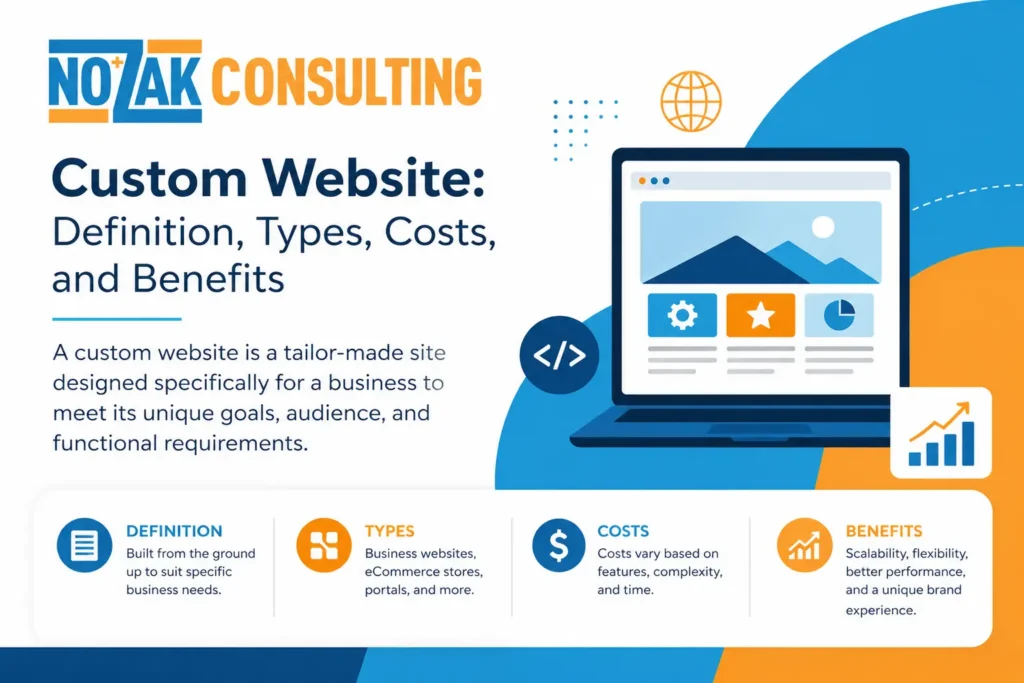
TABLE OF CONTENTS
What is a Custom Website?
A custom website is a fully bespoke digital property — designed, coded, and configured from the ground up to match a specific business, brand, and audience. There is no generic website template. There is no pre-built site builder constraining your layout or functionality. Instead, a team of web designers and web developers creates something that is wholly yours: the page layout, the URL structure, the domain name configuration, the calls to action, the fonts, the color palette, and every integration your business depends on.
The term “custom” distinguishes this approach from off-the-shelf options like Wix, Squarespace, or Weebly, where you pick a template and customize inside a fixed system. A customized website can be built on a flexible CMS like WordPress, a specialized ecommerce platform like Shopify, or written entirely in custom code using HTML, CSS, JavaScript, and backend frameworks. What defines it is control — not the tool.
A custom website is not just about how it looks. It is about how it performs: load speed, crawlability, conversion rate, scalability, and the ability to connect your domain, your CRM, your analytics, and your marketing strategy into one coherent system.
Custom Website vs. Website Builder
The core difference between a custom website and a website builder comes down to three things: control, cost, and scalability. Website builders like Wix, Squarespace, and Webflow offer drag-and-drop interfaces and pre-designed templates that let you publish your website in days. Custom websites require a longer build process but deliver far greater flexibility and long-term performance.
$4–$159
Builder monthly cost
1–2 wks
Builder launch time
$5k+
Custom website cost
8–12 wks
Custom build time
- Custom website
WordPress, Shopify, Webflow
- Fully unique design — no website template reuse
- Complete control over layout, fonts, and brand identity
- Custom domain name connected to your own web hosting
- 8–12 week build process with structured phases
- Higher upfront cost with strong long-term ROI
- Full SEO architecture: schema, URL hierarchy, speed
- Optimized code for faster load times and Core Web Vitals
- Scales infinitely — add features, pages, integrations
- You own the code, design, and data
- Integrates with CRM, analytics, social media, and more
- Website builder / template
Wix, Squarespace, Framer
- Pre-designed templates with limited layout control
- Drag-and-drop editor — no coding required
- Built-in hosting, SSL, and domain management
- Fast to launch: website is live within days
- Low monthly cost with predictable billing
- SEO tools are basic — advanced metadata restricted
- Performance limited by shared infrastructure
- Scalability plateaus as your business grows
- Migration away is complex and time-consuming
- Your website lives on the builder’s platform
When You Need a Fully Custom Website?
If your business relies on its website for lead generation, ecommerce revenue, or brand differentiation — and you plan to grow — a custom website becomes a strategic investment. Businesses processing high transaction volumes, operating in competitive markets, or requiring integrations with tools like Salesforce, HubSpot, or proprietary CRMs need the control and scalability that only custom web development provides.
When a Website Builder is Enough?
For freelancers, early-stage startups, personal blogs, or small local businesses that need to make a website fast on a tight budget, a builder can be sufficient. Platforms like Wix ($16/month), Squarespace ($16/month), or Dorik ($18/month) provide responsive templates, built-in SEO tools, image galleries, and basic ecommerce capabilities — making them accessible ways to create a website without any coding.
What are the Key Features That Define a Truly Custom Website?
The key features that define a truly custom website are unique design and brand identity, tailored functionality, responsive and mobile-first design, SEO-friendly architecture, scalable infrastructure, performance optimization, and analytics/data ownership.
Unique design and brand identity
Every element—page layout, typeface selection, color system, logo placement, illustration style, icon set, and animation—is created specifically for your brand. When a visitor lands on your site, they should feel your brand identity immediately, not recognize a website builder skeleton under the surface.
Responsive and mobile-first design
Responsive websites adapt seamlessly to any screen size — desktop, tablet, or mobile. Custom web development ensures this is handled at the code level, not just through a responsive website template toggle. Every interaction, image, layout adjustment, and font rendering is tested across devices for a consistently seamless experience.
SEO-friendly architecture
custom website is built with clean URL hierarchy, fast load times, proper heading structure, schema markup, canonical tags, and sitemap configuration—all of which help search engines like Google crawl and rank your pages. For businesses whose growth depends on organic search, custom architecture is a competitive advantage.
Scalable infrastructure
Adding new pages, product categories, languages, features, or integrations does not require rebuilding the site. The underlying architecture—hosting environment, CMS configuration, URL structure, and codebase—is designed with long-term scalability in mind. Complex websites that start small can expand to enterprise scale without migration pain.
Performance optimization
Custom web development enables developers to control every aspect of performance: image compression, code minification, lazy loading, CDN configuration, server response times, and Core Web Vitals optimization. Website builders share infrastructure and inject platform code that limits how fast your site can load.
Analytics and data ownership
A custom website connects natively to Google Analytics, Google Search Console, heatmap tools, A/B testing platforms, and your CRM. You own your data. You can track every call to action, every form submission, every ecommerce conversion, and every traffic source—and act on that data to grow your business over time.
What Technologies are Used to Build Custom Websites?
Custom websites are usually built with a CMS, an ecommerce platform, or a headless/custom-coded framework, depending on what the website needs based on its main function: managing content, selling products, or supporting custom functionality.
Content management systems (CMS)
A CMS allows non-technical users to manage content, update pages, and publish blog posts without touching code. WordPress powers over 40% of all websites and offers deep customization via themes, plugins, and custom web development. It is the most common platform for fully custom sites due to its flexibility and ecosystem.
Ecommerce platforms
For online stores, Shopify provides a complete ecommerce solution with built-in payment processing, inventory management, and domain management. Custom Shopify development goes far beyond templates, enabling fully custom checkout flows, product page design, and third-party integrations that reflect your brand identity.
Headless & custom-coded frameworks
For complex web applications, developers use modern JavaScript frameworks like React, Next.js, or Vue alongside backend technologies and APIs. This approach delivers maximum performance, scalability, and flexibility — often used for SaaS platforms, enterprise sites, and businesses with unique workflow requirements.
Some other key technologies are HTML, CSS, and JavaScript for structure and interactivity, along with web hosting (cloud or managed), HTTPS/SSL for security, a content delivery network (CDN) for performance, a domain registrar for your site address, and integrations like Google Search Console, analytics, CRM systems, URL redirection, schema markup, email marketing tools, and social media platforms to enhance functionality, visibility, and user engagement.
What is the Custom Website Design and Development Process?
Building a professionally designed website from scratch follows a structured process. This ensures the final product aligns with your business goals, satisfies user intent, and is built to rank, convert, and scale.
Project Planning
Define business goals, target audience, competitor landscape, and key user journeys. Establish site architecture, URL structure, and content strategy. This stage determines how your website will grow your business.
Site Architecture & Wireframing
Map the page layout and navigation hierarchy before any design work begins. Wireframes define where calls to action, images, forms, and content blocks live on each page — prioritizing usability and conversion paths.
UI/UX design
Create distinctive designs that reflect your brand. Typography, color palette, logo integration, and animation. The goal is a professional custom website that connects with your audience and converts them into customers.
Website Development
Developers translate approved designs into working, optimized code. This includes frontend development (HTML, CSS, JavaScript), CMS configuration (WordPress, Shopify), backend logic, API integrations, ecommerce setup, and form functionality.
Search Engine Optimization
Implement complete SEO foundations: URL hierarchy, XML sitemap, robots.txt, content optimization, structured data (schema markup), page speed optimization and Google Search Console and Analytics setup.
Testing & Quality Assurance
Test across devices, browsers, and screen sizes. Validate responsiveness, load speed, form submissions, ecommerce checkout flows, analytics tracking, and accessibility. No website is live until it passes thorough QA.
Launch & Domain Configuration
Connect the custom domain name via a domain registrar. Configure web hosting, HTTPS, content delivery network (CDN), and DNS records. The website goes live and monitoring begins.
Growth & Ongoing Management
Keep your site fresh with content updates, security patches, performance monitoring, and analytics review. Ongoing work connects with your audience, grows your website traffic, and supports long-term business goals.
What are the Benefits of a Custom Website for Businesses?
The benefits of a custom website for businesses can be lead volume, brand perception, and organic search traffic—all improve when a site is built with strategy, not just speed. For businesses that treat their website as a growth tool—not just a digital brochure—the long-term return on investment from a custom website consistently outweighs the upfront cost.
What you gain
- Stronger lead generation and conversion rates
- Distinctive brand identity that sets you apart
- Better search engine rankings and organic traffic
- Faster load times and improved user experience
- Scalability as your business grows
- Full ownership of code, design, and data
- Custom integrations with CRM, email, social media
- Complete control over domain and hosting
What to plan for
- Higher upfront investment ($5,000–$15,000+)
- Longer build timeline (8–12+ weeks)
- Ongoing maintenance and update costs
- Requires professional web design expertise
- More complex than a website builder to launch
- Annual hosting and domain name costs
How Much Does a Custom Website Cost?
The cost of a custom website depends on scope, complexity, and the experience level of the team building it. Below is a practical breakdown to help you plan your budget.
| Tier | Typical cost |
|---|---|
| Small custom | $3,000–$8,000 |
| Mid-range | $8,000–$25,000 |
| Ecommerce | $10,000–$40,000 |
| Enterprise | $25,000–$100,000+ |
| Ongoing maintenance | $1,000–$5,000/yr |
- Small custom website: Best for local service businesses, consultants, and small professional firms. Usually includes 5–10 pages, a CMS, basic SEO setup, responsive design, and a contact form.
- Mid-range custom website: Best for growing SMBs, multi-service companies, and businesses that need more than a simple brochure site. Usually includes custom UI/UX design, advanced functionality, CRM integration, a blog, analytics, and stronger conversion-focused structure.
- Ecommerce website: Best for online stores, product brands, and businesses selling physical or digital products. Usually includes Shopify or WooCommerce setup, product catalog, checkout, payment gateway integration, inventory features, and ecommerce tracking.
- Enterprise custom website: Best for larger businesses, SaaS companies, franchises, and organizations with more complex requirements. Usually includes a custom framework, advanced integrations, CRM or ERP connections, multi-language functionality, high-traffic performance planning, and stronger security considerations.
- Ongoing website maintenance: Recommended for all custom websites after launch. Usually includes security patches, software updates, performance monitoring, backups, bug fixes, and small content changes.
A custom domain name typically costs $10–$20/year. Web hosting ranges from $20/month for managed WordPress to several hundred per month for enterprise-grade cloud hosting. HTTPS and SSL are standard. When evaluating cost, compare total cost of ownership over three to five years, including the value of leads, revenue, and brand equity the site generates.
| Tier | Typical cost | What’s included | Best for |
|---|---|---|---|
| Small custom | $3,000–$8,000 | 5–10 pages, CMS, basic SEO setup, responsive design, contact form | Local service businesses, consultants |
| Mid-range | $8,000–$25,000 | Custom UI/UX design, advanced functionality, CRM integration, blog, analytics | Growing SMBs, multi-service companies |
| Ecommerce | $10,000–$40,000 | Shopify or WooCommerce, product catalog, checkout, payment gateway, inventory | Online stores, product brands |
| Enterprise | $25,000–$100,000+ | Custom framework, advanced integrations, CRM/ERP, multi-language, high traffic | Large businesses, SaaS, franchises |
| Ongoing maintenance | $1,000–$5,000/yr | Security patches, updates, performance monitoring, content changes | All custom websites post-launch |
A custom domain name typically costs $10–$20/year. Web hosting ranges from $20/month for managed WordPress to several hundred per month for enterprise-grade cloud hosting. HTTPS and SSL are standard. When evaluating cost, compare total cost of ownership over three to five years, including the value of leads, revenue, and brand equity the site generates.
Who Needs a Custom Website?
For businesses where the website is a core revenue and growth engine, a custom build is the right investment.
Local service businesses
Plumbers, contractors, clinics, and agencies competing for local search rankings and lead generation
Ecommerce brands
Online stores needing fully custom checkout, product pages, and ecommerce workflows
Multi-location companies
Businesses with multiple regions, service areas, or offices that need scalable, structured site architecture
Growing startups
Startups with product-led growth, user accounts, or investor-facing materials that demand professional design
Competitive markets
Any business in a saturated vertical where brand differentiation and organic search are strategic priorities
B2B & enterprise
Companies selling complex products or services that require custom marketing strategy, content, and CRM integration
What is the Difference Between Web Design and Web Development?
A successful custom website requires two complementary disciplines working together. Conflating them leads to misaligned expectations and gaps in quality.
Web design (UI/UX)
- Page layout and visual hierarchy
- Typography, fonts, and color palette
- Logo, iconography, and illustration
- User experience and conversion flow
- Call to action placement
- Animation and interaction design
- Brand identity expression
- Mobile-first responsive design
Web development (coding)
- HTML, CSS, and JavaScript coding
- CMS or ecommerce platform setup
- Backend functionality and APIs
- Domain and web hosting configuration
- Performance and speed optimization
- SEO technical implementation
- Analytics and tracking integration
- Security, HTTPS, and maintenance
The best custom website projects have both roles involved from day one. Design decisions affect development complexity; technical constraints shape design possibilities. A web design agency that handles both disciplines delivers a more coherent, optimized, and strategically aligned product.
How Does AI Fit Into Custom Website Design and Building?
AI is already becoming part of modern website design and development. Platforms like WordPress and Wix now use AI to help businesses generate layouts, content, and complete website drafts faster.
WordPress.com also launched an AI website builder that generates layouts, content, and designs in minutes, and says AI-generated sites can later be expanded with plugins for forms, SEO, membership, e-commerce, and other business features.
For businesses, this means AI should not be seen as something to fear. It should be seen as a way to make a website more productive, easier to manage, and more useful for customers.
Features such as AI chatbots, live chat, personalized recommendations, smarter search, and automated support are becoming important parts of the online customer experience.
So the best results come when AI is used with a clear business purpose. A custom-built website gives businesses the flexibility to use AI where it creates real value, whether that means generating leads, answering customer questions faster, improving content, automating repetitive tasks, or creating a more personalized user journey.
How to Choose the Right Web Design Agency for Your Custom Website?
The right agency brings together web design, web development, content strategy, and performance optimization into a single, coherent process — and they make the effort to understand your business goals before touching a single design element.
What to look for in a web design agency
- A portfolio of fully custom websites, not just template modifications or web builders, that demonstrate genuine design range and technical depth
- Proven experience with SEO architecture: URL structure, schema markup, Core Web Vitals, and Google Search Console integration built into the development process
- A clear, structured process covering discovery, wireframing, UI/UX design, development, testing, and launch — not just "we build websites"
- Transparency around technology: which CMS or ecommerce platform they recommend for your needs, and why, whether that's WordPress, Shopify, or Webflow
- Clarity on domain registration, web hosting, HTTPS, and ongoing maintenance, so you are never left dependent on a third party to access your own website
- A pricing structure that reflects the scope of work, not a suspiciously low flat fee that signals a template build in disguise
Questions to ask before you hire
- Can you walk me through a recent custom website project from discovery to launch?
- Who owns the domain, hosting account, and website code once the project is complete?
- How do you approach technical SEO? Is it built in from the start or added at the end?
- What CMS platform would you recommend for my business, and why?
- How do you handle responsive design and mobile performance?
- What does the handover process look like? What ongoing support do you offer after launch?
The right web design agency builds a system aligned to your business goals. If an agency cannot articulate how their work will grow your business, connect with your audience, and support your long-term marketing strategy, keep looking.
Ready to build a website that grows your business?
A custom website is not just a design project. It is fully-functional system — built to attract your ideal customers, reflect your brand, and convert visitors into revenue. The next step is a conversation about your goals.
Frequently Asked Questions About Custom Websites
What is the difference between a custom website and a template?
A custom website is designed from scratch specifically for your brand, with no template baseline offer unique design, tailored functionality, and better performance and SEO outcomes. A template is a pre-designed layout you fill with your content.
How long does it take to build a custom website?
A typical custom website takes 8–12 weeks from discovery to launch. More complex projects with advanced ecommerce, custom integrations, or enterprise-level features can take 4–6 months. Website builders, by contrast, allow you to publish your website in days or weeks.
Is WordPress a custom website?
Technically, yes. WordPress is a CMS platform that allows you to build custom website design and unique functionality based on your brand’s needs.
What is a custom domain name and do I need one?
A custom domain name is a URL you own and register, such as yourbrand.com, rather than a subdomain provided by a builder (like yourbrand.wix.com). Any professional website should use a custom domain. It strengthens your brand, improves trust with visitors, and supports long-term SEO by making your website easier to recognize and build authority overtime.
Can a custom website help with SEO?
Yes, significantly. Custom websites can be built with full technical SEO control: clean URL structures, schema markup, fast load times, proper heading hierarchy, Google Search Console integration, and optimized Core Web Vitals. Website builders offer some SEO tools but restrict deep customization, limiting your ability to compete in search.
How much does a custom website cost in 2026?
Custom website costs range from $3,000–$8,000 for a small business site, $8,000–$25,000 for a mid-range project, $10,000–$40,000 for ecommerce, and $25,000–$100,000+ for enterprise builds. Ongoing maintenance typically adds $1,000–$5,000 per year. Domain registration and web hosting are additional annual costs.
Can a custom website be built on Shopify or WordPress?
Yes. Shopify and WordPress are the most common platforms for custom website development. The platform provides the foundation; what makes it custom is the unique design, bespoke functionality, and professional development work built on top of it.
Ready to build a website that grows your business?
A custom website is not just a design project. It is fully-functional system — built to attract your ideal customers, reflect your brand, and convert visitors into revenue. The next step is a conversation about your goals.